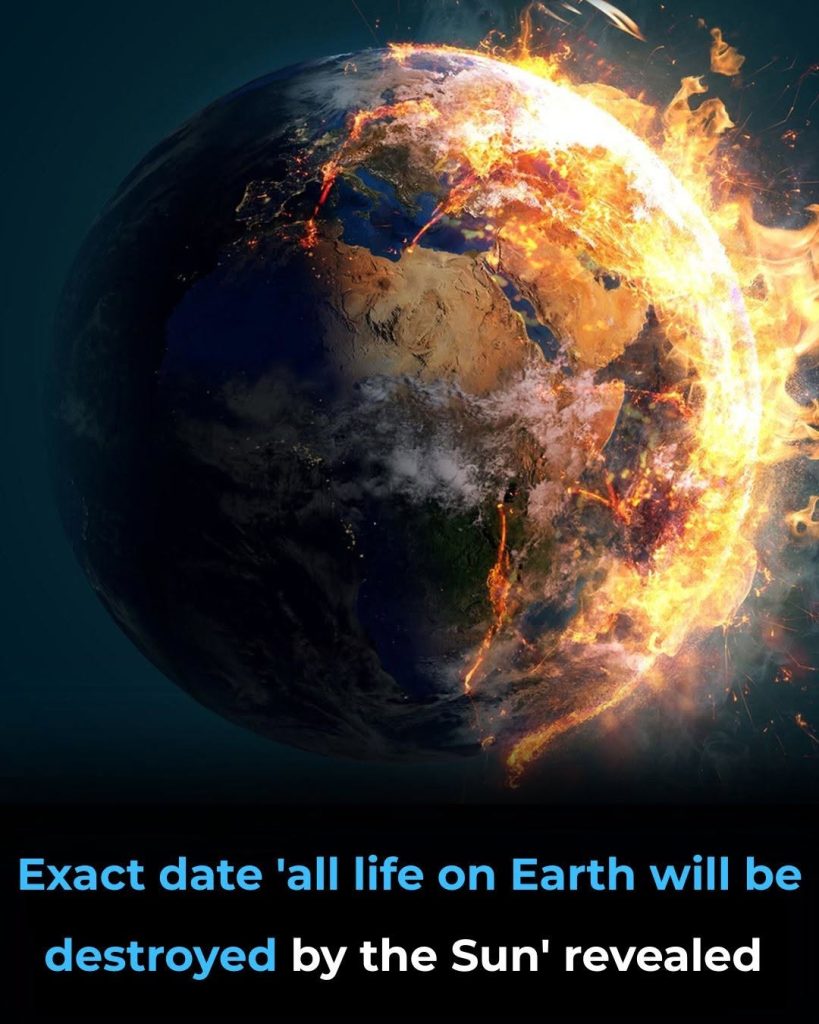
Scientists Confirm the Timeline for Earth’s Destruction as Predicted by Elon Musk
Earth may seem like a permanent home for humanity, but scientists have long known that our planet will not remain habitable forever. The ultimate reason is connected to the evolution of the Sun.
As the Sun ages, it will gradually become brighter and hotter. Over an extremely long period of time, these changes will affect Earth’s climate, atmosphere, oceans, and ability to support life.
Recent scientific modeling has provided a clearer picture of what could happen to Earth in the distant future.
The Sun Will Not Stay the Same Forever
The Sun is currently a stable star, but it is slowly changing.
As it continues to age, its brightness will gradually increase. This means that Earth will receive more energy from the Sun over hundreds of millions of years.
At first, these changes may seem insignificant. However, over enormous periods of time, even small changes in the Sun’s brightness can have major consequences for Earth’s environment.
Eventually, the increasing heat will make Earth’s climate increasingly difficult for life to survive.
Earth Could Lose Its Oxygen
One of the most important findings discussed in the article concerns Earth’s atmosphere.
Scientists used mathematical models and computer simulations to examine how the planet’s atmosphere could change as the Sun becomes brighter.
According to the study discussed by the article, Earth’s atmosphere could remain relatively stable for roughly another 1.08 billion years, although there is considerable uncertainty around this estimate.
As the Sun becomes brighter and Earth’s environment changes, biological processes that help maintain atmospheric oxygen could eventually decline.
Plants and other oxygen-producing organisms would gradually struggle to survive under increasingly difficult conditions.
As a result, atmospheric oxygen levels could eventually fall dramatically.
Most Complex Life Would Eventually Disappear
A significant reduction in oxygen would have enormous consequences for life on Earth.
Humans, animals, and many other organisms depend on oxygen for survival. If oxygen levels fell far below today’s levels, complex life would eventually become impossible.
According to the scenario described in the article, a mass extinction would occur as Earth’s environment became increasingly hostile.
Eventually, only certain microorganisms capable of surviving without oxygen could remain.
This would not happen suddenly. It would be a very slow process taking place over hundreds of millions of years.
What Will Happen to the Sun?
The eventual destruction of Earth’s habitability is not the end of the Sun’s story.
In roughly five billion years, the Sun is expected to enter a completely different stage of its life.
It will eventually run out of hydrogen fuel in its core and expand into a red giant.
During this stage, the Sun will become enormously larger than it is today.
The inner planets, including Mercury and Venus, are expected to be engulfed by the expanding Sun. Earth’s ultimate fate is less certain, but it could also be engulfed or become completely uninhabitable long before that happens.
Elon Musk’s Warning
Elon Musk has frequently discussed the long-term survival of humanity.
Musk argues that if humanity remains limited to a single planet, it will eventually face an unavoidable existential threat because Earth will not remain habitable forever.
He has therefore promoted the idea of establishing a self-sustaining human civilization on Mars.
Musk has described Mars as a form of “life insurance” for humanity.
His argument is that if humans become a multiplanetary species, the survival of civilization would no longer depend entirely on Earth.
Why Mars Is Important to Musk
Musk’s long-term vision goes beyond simply sending astronauts to Mars.
His goal is to establish a settlement that could eventually survive independently from Earth.
For such a civilization to be truly self-sustaining, it would need to produce its own resources, food, energy, technology, and infrastructure.
Musk has argued that a Mars settlement would not truly protect humanity if it depended permanently on supplies from Earth.
If communication or transportation between Earth and Mars were interrupted, a self-sustaining settlement would need to continue functioning on its own.
SpaceX and the Future of Mars
SpaceX, Musk’s space company, has made human missions to Mars one of its major long-term ambitions.
The company is developing Starship, a large reusable spacecraft designed to transport people and cargo into space.
The long-term vision involves using large spacecraft to transport significant numbers of people and supplies to Mars.
However, establishing a permanent human civilization on Mars remains an enormous technological challenge.
Humans would need to deal with radiation, extreme temperatures, limited resources, low atmospheric pressure, and the absence of a naturally breathable atmosphere.
Is Earth Really Going to Be Destroyed Soon?
No.
The timescales involved are so enormous that there is no reason for people today to interpret this as an immediate threat.
The estimated decline in Earth’s habitability occurs on a timescale of roughly one billion years, while the Sun’s red giant phase is expected in roughly five billion years.
These are astronomical timescales far beyond the existence of modern human civilization.
The research is therefore about understanding the long-term evolution of planets and stars, rather than predicting an imminent disaster.
What Does the Research Actually Tell Us?
The important scientific point is that Earth’s habitability has a natural limit.
Earth’s environment depends on a delicate balance between the Sun, atmosphere, oceans, geology, and living organisms.
As the Sun becomes brighter, this balance will eventually be disrupted.
The research described in the article used large numbers of simulations to examine how atmospheric gases and climate conditions could change over extremely long periods.
These models provide scientists with a way to explore possible futures that cannot be observed directly because they occur over timescales much longer than human history.
The Future of Humanity
The distant future raises an important question: Could humanity survive beyond Earth?
At present, humans are completely dependent on Earth for food, water, breathable air, and a stable environment.
Mars is extremely difficult to live on, and creating a truly self-sustaining civilization there would require technologies that do not yet exist at the necessary scale.
Nevertheless, space exploration and the development of reusable rockets are steps toward understanding whether humans could eventually live beyond Earth.
A Reminder About Our Planet
Although the destruction of Earth’s habitability is billions of years away, the story also highlights the importance of protecting our planet today.
Human activities can already affect Earth’s climate, ecosystems, atmosphere, and biodiversity.
These modern environmental problems are completely different from the Sun’s natural evolution, but they remind us that Earth’s habitability is not something humans should take for granted.
The planet remains our only proven home.
Conclusion
Scientists have long understood that the Sun will eventually become brighter, hotter, and ultimately transform into a red giant.
New computer models provide estimates suggesting that Earth’s atmosphere could undergo dramatic changes in roughly one billion years, potentially causing the extinction of most complex life long before the Sun reaches its red giant stage.
Elon Musk has used this distant future as one reason for advocating a multiplanetary civilization.
His vision is to establish a self-sustaining human settlement on Mars so that humanity would not depend entirely on Earth for its long-term survival.
However, none of this means that Earth is facing destruction anytime soon.
The timescales involved are measured in billions of years. For humanity today, the more immediate challenge is protecting the planet we already have while continuing to explore the possibilities of life beyond Earth.
The distant future may be impossible to predict in every detail, but one thing is clear: Earth will not remain habitable forever, and understanding the evolution of our planet and the Sun helps scientists better understand the long-term future of life itself.