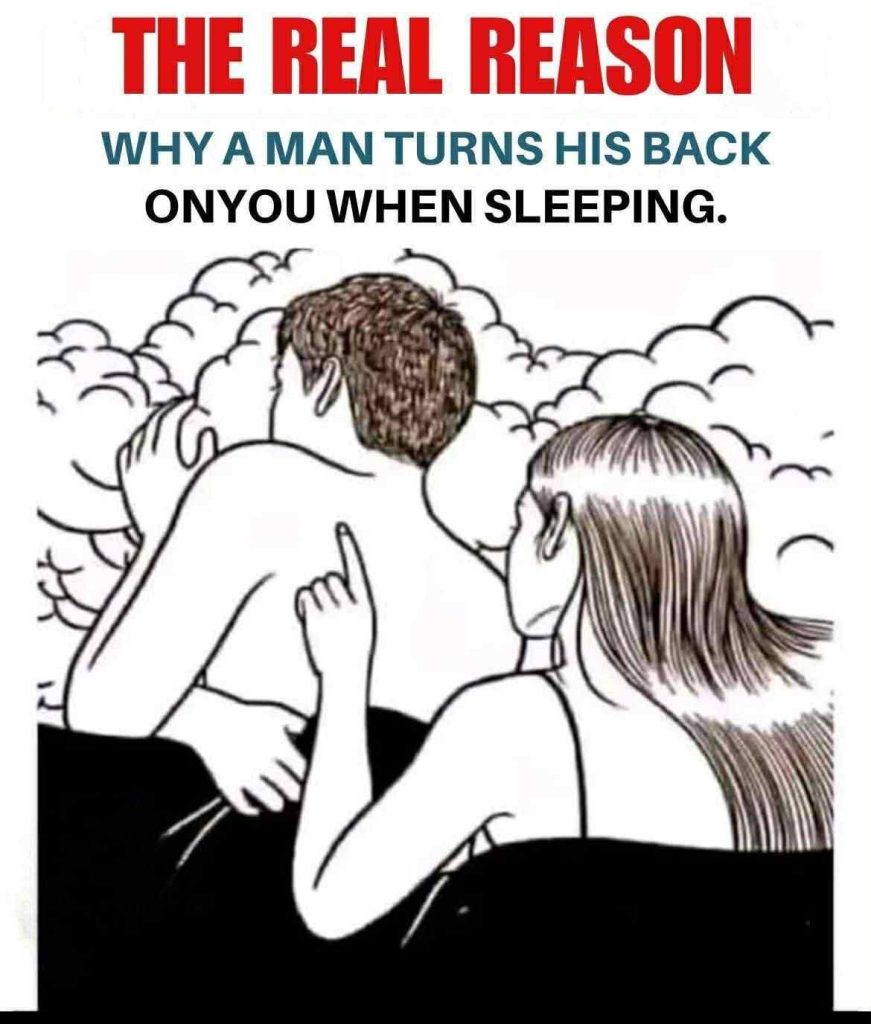
What It May Mean When Your Partner Sleeps With Their Back to You
Have you ever gone to bed next to your partner and noticed that they sleep with their back facing you?
It is easy to look at this sleeping position and wonder whether it says something about the relationship.
Does it mean your partner is emotionally distant?
Are they angry with you?
Or could it simply be the most comfortable way for them to sleep?
The truth is that sleeping positions can have different meanings, and one position alone cannot tell you everything about a relationship.
Sleeping With Your Back to Your Partner
When one partner sleeps with their back toward the other, it can sometimes be interpreted as a sign of emotional distance.
However, that interpretation is not necessarily correct.
People often change positions during sleep without consciously thinking about it.
A person may simply turn over because that position feels more comfortable or because they sleep better that way.
Therefore, seeing your partner’s back does not automatically mean that they are rejecting you.
It Can Also Mean Comfort and Security
Interestingly, sleeping with your back toward your partner can sometimes happen because a person feels comfortable and secure.
When people feel safe with someone, they may not feel the need to remain physically connected throughout the entire night.
They may be comfortable enough to relax completely and sleep in whatever position feels natural.
In this sense, physical distance during sleep does not necessarily represent emotional distance.
Personal Sleeping Habits Matter
Everyone has their own preferred sleeping position.
Some people sleep on their side.
Others sleep on their stomach or back.
Some people move around frequently during the night, while others barely move.
If your partner has always preferred sleeping on their side with their back toward you, it may simply be a personal habit rather than a message about your relationship.
Temperature Can Play a Role
Another practical explanation is temperature.
Two people sleeping close together can generate a lot of body heat.
If one partner tends to feel warmer than the other, they may naturally move away during the night.
Turning their back or creating a little space can help them stay comfortable.
This has nothing to do with a lack of affection.
It is simply a matter of physical comfort.
The Meaning May Change Over Time
A sleeping position can sometimes change depending on what is happening in a relationship.
For example, couples who are experiencing stress, conflict, or emotional tension may naturally become less physically affectionate.
If someone suddenly stops cuddling, moves away during sleep, and also becomes emotionally distant during the day, the combination of behaviors may be worth discussing.
But the sleeping position itself is not enough to prove that something is wrong.
Other Sleeping Positions
Couples sleep in many different positions.
Some sleep face-to-face.
Others sleep back-to-back.
Some hold each other throughout the night.
Others prefer to have significant space between them.
There is no single sleeping position that defines a healthy relationship.
What matters more is how the partners feel about each other when they are awake.
Back-to-Back Sleeping
Back-to-back sleeping can actually be completely normal.
Some couples find it comfortable because both people can sleep without disturbing each other.
They may still feel emotionally close even though their bodies are facing opposite directions.
In some cases, couples may even touch each other’s backs or legs while sleeping, creating physical contact without having to face one another.
The Important Difference: Sleep vs. Emotional Behavior
One of the biggest mistakes people can make is trying to interpret unconscious behavior as a deliberate message.
A person does not necessarily choose their sleeping position consciously.
Instead, it is often determined by comfort, habit, temperature, mattress position, physical conditions, and normal movement during sleep.
If you are concerned about your relationship, pay more attention to how your partner communicates and behaves while awake.
When Should You Pay Attention?
A change in sleeping behavior may be worth discussing if it happens together with other significant changes.
For example:
- Your partner avoids physical affection when awake.
- Communication has become noticeably colder.
- You spend much less time together.
- Arguments have become more frequent.
- Your partner seems emotionally withdrawn.
- They consistently avoid closeness both during the day and at night.
Even then, these behaviors do not automatically mean that the relationship is in trouble.
They simply indicate that a conversation may be helpful.
Communication Is More Important Than Sleeping Positions
If your partner has recently started sleeping with their back toward you and it makes you feel worried, the best approach is not to assume what it means.
Instead, talk openly.
You might say:
“I’ve noticed that we’ve been sleeping differently lately. Is everything okay between us?”
A calm conversation can provide much more useful information than trying to interpret body language while someone is asleep.
Don’t Overthink It
It is natural to wonder what your partner’s sleeping position means.
However, it is easy to turn a completely normal sleeping habit into a source of unnecessary anxiety.
Your partner may simply be tired.
They may be too warm.
They may have a preferred sleeping position.
They may have moved during the night without even realizing it.
None of these things necessarily reflect their feelings toward you.
What Really Matters in a Relationship
A healthy relationship is built on communication, trust, respect, affection, and emotional connection.
Those qualities are much more meaningful than whether two people face each other while sleeping.
If you and your partner communicate openly, support one another, enjoy spending time together, and feel emotionally connected, sleeping back-to-back is unlikely to be a problem by itself.
Conclusion
When your partner sleeps with their back toward you, it does not automatically mean that they are emotionally distant or unhappy in the relationship.
The position may simply reflect comfort, personal preference, temperature, or unconscious movement during sleep.
If the sleeping position is part of a larger pattern of emotional withdrawal, it may be worth having an honest conversation.
But one sleeping position should never be treated as a definitive diagnosis of a relationship.
Instead of guessing what your partner’s sleeping position means, focus on how the two of you communicate, connect, and treat each other when you are awake.