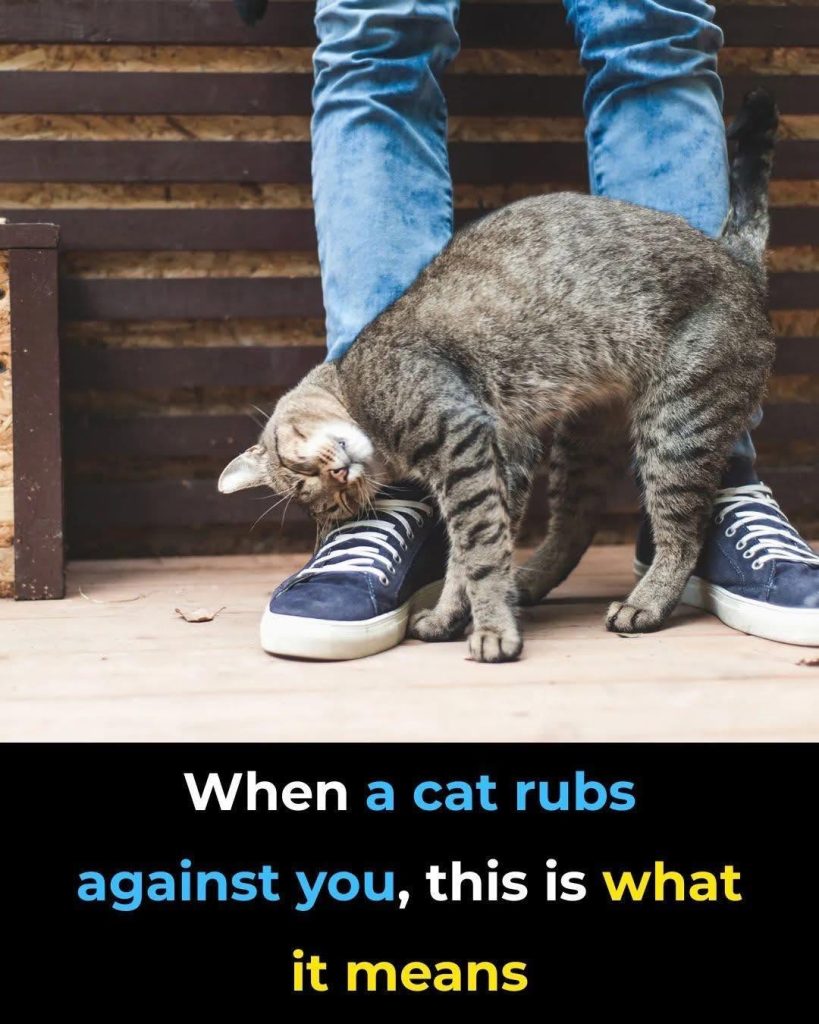
When a Cat Rubs Against You, This Is What It Really Means
That Little Headbutt or Leg Rub May Be Saying More Than You Think
If you’ve ever had a cat rub its face against your hand, weave between your legs, or gently bump its head against you, you may have wondered what it is trying to say.
Is your cat showing affection?
Is it asking for food?
Or is there another reason behind this surprisingly common behavior?
The answer is actually a little more interesting than simply saying, “Your cat loves you.”
Cats use rubbing as a form of communication. It can be connected to greeting, social bonding, scent marking, gathering information, or asking for something.
So the next time your cat walks over and starts rubbing against you, here’s what may be happening.
1. Your Cat May Be Saying Hello
One of the most common reasons cats rub against people is simply to greet them.
You may notice this especially after you’ve been away from home. Your cat might approach with its tail held up, rub along your legs, and then follow you around the room.
This can be a friendly social interaction.
Cats also use rubbing and head-bumping behaviors with familiar cats, so when your cat does it to you, it can be part of the way they recognize and interact with someone they trust.
In other words, that enthusiastic welcome when you walk through the door may genuinely be your cat’s way of acknowledging you.
2. They’re Leaving Their Scent on You
Here’s the fascinating part.
Cats have scent glands around areas including their cheeks, chin, forehead, and the base of the tail.
When they rub against you, they can deposit scent and pheromones onto your skin or clothing.
This helps cats communicate information about familiarity and their social environment.
It’s one reason a cat may rub against furniture, doorways, other animals, and people.
So when your cat repeatedly rubs against your legs, it isn’t necessarily being possessive in the human sense.
It’s engaging in a normal feline behavior that helps create a familiar scent environment.
3. Your Cat May Want Something
Sometimes the message is much simpler:
“Pay attention to me!”
Cats quickly learn which behaviors get a response from their humans.
If rubbing against your legs results in food, petting, playtime, or a door being opened, your cat may learn to repeat the behavior whenever it wants that particular thing.
Your cat might be asking for:
- Food
- Treats
- Petting
- Playtime
- Attention
- Access to another room or the outdoors
The surrounding behavior can give you clues.
For example, a cat rubbing against your legs near its food bowl may have a very different request from a cat rubbing against you before curling up beside you for a nap.
4. They May Be Checking You Out
Cats rely heavily on scent to understand their environment.
When you come home, you bring new smells with you—from other people, animals, places, and objects.
Your cat may rub against you while also investigating those unfamiliar scents.
In this situation, the rubbing isn’t necessarily a request for affection.
Your cat may simply be gathering information about where you’ve been and what has changed since you left.
This is another reason feline rubbing is better understood as a form of communication rather than having one single meaning.
5. It Can Be a Sign of Trust and Social Bonding
A cat that comfortably approaches you, rubs against you, and displays relaxed body language is often showing that it feels secure around you.
Head rubbing, sometimes called bunting, can be part of friendly social interaction.
You may also notice other relaxed behaviors at the same time, such as:
- A relaxed body
- An upright or gently curved tail
- Slow blinking
- Purring
- Staying close to you
- Seeking gentle petting
None of these signals should be interpreted completely on their own, but together they can help you understand how your cat is feeling.
What If Your Cat Rubs Against You Constantly?
Frequent rubbing isn’t automatically a reason for concern.
Some cats are simply more social and attention-seeking than others.
However, if a behavior suddenly becomes excessive or is accompanied by other unusual signs, it’s worth paying attention.
Changes in behavior can sometimes be associated with stress, discomfort, or an underlying medical issue.
The important thing is to look for a change from your cat’s normal behavior, rather than assuming that frequent rubbing is automatically a problem.
What About Female Cats in Heat?
There’s another situation in which rubbing can become noticeably more frequent.
Unspayed female cats in heat may become unusually affectionate and may rub against people, furniture, or other animals more often.
Other signs can include increased vocalization, restlessness, and changes in body posture.
If you’re unsure whether your cat is experiencing a reproductive cycle or another behavioral change, a veterinarian can help determine what’s happening.
Spaying also prevents unwanted pregnancies and eliminates heat cycles in female cats.
Should You Always Pet a Cat That Rubs Against You?
Not necessarily.
Rubbing often means your cat is comfortable approaching you, but it doesn’t automatically mean they want unlimited physical contact.
Let your cat’s body language guide you.
If your cat remains relaxed and continues approaching you, gentle interaction may be welcome.
If the cat moves away, flattens its ears, flicks its tail rapidly, or otherwise appears uncomfortable, give it some space.
Respecting those signals can help build trust.
What Does It Mean When a Cat Rubs Against Your Legs?
This is probably the behavior most cat owners recognize.
Your cat walks toward you, circles your legs, rubs against one side, then comes back for another pass.
It can look almost like a tiny furry obstacle course.
But there’s usually communication happening at the same time.
Your cat may be:
Greeting you.
Leaving familiar scent behind.
Seeking attention.
Asking for something.
Or simply reinforcing its connection with you.
The exact meaning depends on the situation and the rest of the cat’s body language.
The Bottom Line
When a cat rubs against you, there’s usually more going on than a simple request for cuddles.
It’s one of the ways cats communicate with the people and animals around them.
The behavior can mean hello, I recognize you, you are familiar to me, pay attention to me, or I want something from you.
And yes, it can also be part of a friendly social bond.
So the next time your cat walks over and presses its head against your leg, you don’t have to wonder whether it means anything.
It does.
Your cat is communicating in its own language.
And once you learn to recognize the signs, those little rubs can become one of the easiest ways to understand what your feline companion is trying to tell you.