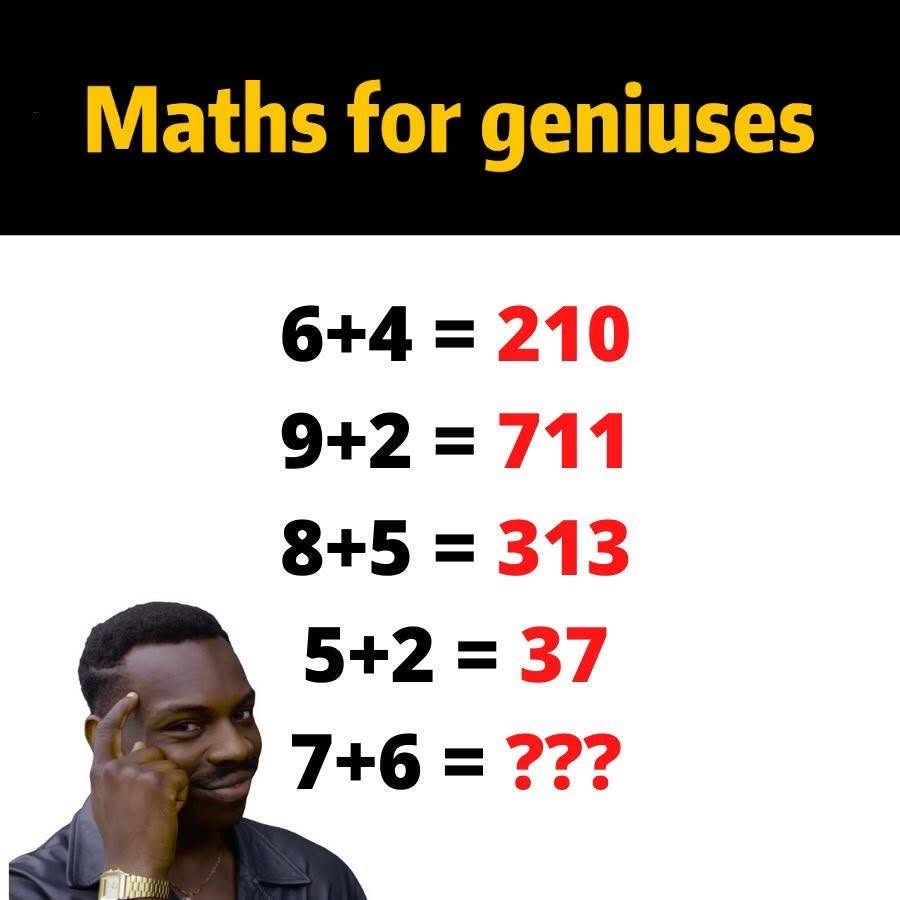
Maths for Geniuses? Can You Solve This Number Puzzle?
A Mind-Bending Math Puzzle That Will Challenge Your Critical Thinking
At first glance, the equations in this puzzle seem completely wrong.
Take a look:
- 6 + 4 = 210
- 9 + 2 = 711
- 8 + 5 = 313
- 5 + 2 = 37
- 7 + 6 = ???
Anyone who knows basic arithmetic would immediately notice that these answers cannot be correct in the usual sense.
After all, 6 + 4 equals 10—not 210.
So what is the secret?
The answer is that this is not a normal addition problem. It is a pattern-recognition puzzle in which the plus sign does not represent ordinary addition in the final answer.
The challenge is to discover the hidden rule.
Look Beyond Ordinary Addition
When solving a puzzle like this, the first step is to stop thinking about standard arithmetic.
Instead, look at the relationship between the numbers on the left and the unusual answers on the right.
Ask yourself:
- Is the answer made from two separate numbers?
- Is subtraction involved?
- Is addition involved in another way?
- Are two results being joined together?
- Does the same rule work for every equation?
Let’s examine the examples one by one.
The First Equation: 6 + 4 = 210
Start with:
6 + 4 = 210
First, find the difference between the two numbers:
6 − 4 = 2
Then find their sum:
6 + 4 = 10
Now put the two results together:
2 + 10 → 210
So the answer is:
210
The first equation fits the pattern.
The Second Equation: 9 + 2 = 711
Now consider:
9 + 2 = 711
Find the difference:
9 − 2 = 7
Find the sum:
9 + 2 = 11
Put the two results together:
7 + 11 → 711
Again, the pattern works perfectly.
The Third Equation: 8 + 5 = 313
Now look at:
8 + 5 = 313
The difference is:
8 − 5 = 3
The sum is:
8 + 5 = 13
Put them together:
3 + 13 → 313
Once again, the answer matches the puzzle.
The Fourth Equation: 5 + 2 = 37
The final example is:
5 + 2 = 37
Find the difference:
5 − 2 = 3
Find the sum:
5 + 2 = 7
Put the two results together:
3 + 7 → 37
The same rule works again.
Now Solve the Final Puzzle
The final equation is:
7 + 6 = ???
Following exactly the same pattern:
Step 1: Find the difference
7 − 6 = 1
Step 2: Find the sum
7 + 6 = 13
Step 3: Put the two results together
1 + 13 → 113
Therefore:
7 + 6 = 113
The Hidden Rule
The entire puzzle follows this simple pattern:
Difference + Sum = Final Answer
More precisely, the answer is formed by writing the difference first, followed immediately by the sum.
For two numbers, A and B:
A − B = Difference
A + B = Sum
Then:
Difference + Sum → Final Answer
For example:
8 + 5
Difference:
8 − 5 = 3
Sum:
8 + 5 = 13
Final answer:
313
Why Is This Puzzle Tricky?
The puzzle is designed to make your brain automatically use ordinary arithmetic.
When you see:
6 + 4
your brain immediately thinks:
10
But the answer displayed is:
210
That apparent contradiction encourages you to search for another explanation.
The real challenge is not performing difficult mathematics. It is recognizing that the puzzle is using a different rule.
This is why these puzzles are often described as tests of logical thinking rather than mathematical ability.
What Skills Does This Puzzle Test?
Number-pattern puzzles can encourage several useful thinking skills, including:
- Logical reasoning
- Pattern recognition
- Creative thinking
- Attention to detail
- Flexible problem-solving
- Patience
- Analytical thinking
These skills can be useful not only in mathematics but also in science, programming, engineering, and everyday problem-solving.
Why Can People Find Different Answers?
Some pattern puzzles can have more than one possible solution.
This happens because people naturally look for different relationships between numbers.
A person might discover a rule that works for one or two examples but fails on the others.
The strongest solution is normally the one that explains all of the examples consistently.
In this puzzle, the difference-followed-by-sum rule works for every equation:
- 6 + 4 → 2 and 10 → 210
- 9 + 2 → 7 and 11 → 711
- 8 + 5 → 3 and 13 → 313
- 5 + 2 → 3 and 7 → 37
- 7 + 6 → 1 and 13 → 113
Try Creating Your Own Puzzle
Once you understand the pattern, you can create your own.
For example:
12 + 7 = ?
Difference:
12 − 7 = 5
Sum:
12 + 7 = 19
Final answer:
519
Another example:
15 + 9 = ?
Difference:
15 − 9 = 6
Sum:
15 + 9 = 24
Final answer:
624
You can use the same idea to challenge your friends and family.
Tips for Solving Similar Number Puzzles
When you encounter a puzzle like this, try the following approach:
- Don’t assume the symbols have their normal mathematical meaning.
- Compare all of the examples.
- Look for repeated relationships.
- Try subtraction, multiplication, division, or combinations of operations.
- Check whether the answer might be made by joining two separate results.
- Test your theory against every example.
- Choose the simplest rule that consistently explains the entire puzzle.
The key is to avoid forcing a rule that only works for one example.
Final Answer
The puzzle may look impossible at first, but the hidden pattern is actually quite simple.
For 7 + 6:
Difference: 7 − 6 = 1
Sum: 7 + 6 = 13
Put them together:
1 + 13 → 113
The Answer Is 113
The real trick is not complicated mathematics. It is simply looking at a familiar problem from a different perspective.
Sometimes, the answer becomes obvious once you stop asking, “What is the normal calculation?” and start asking, “What rule is the puzzle using?”