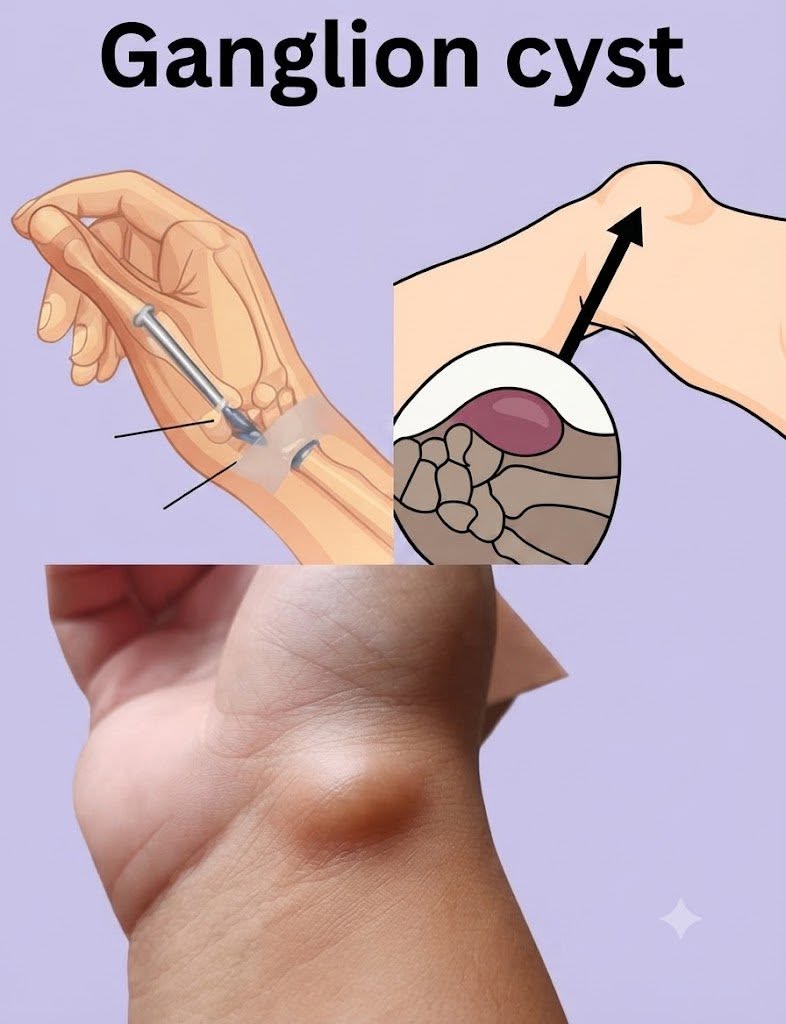
A Wrist Bump Doesn’t Always Mean Something Serious — It Could Be a Ganglion Cyst
Finding a lump or bump on your wrist can be alarming. Many people immediately worry that it could be something dangerous.
However, not every wrist lump is a sign of a serious disease.
One common explanation is a ganglion cyst, a fluid-filled lump that often develops near a joint or tendon. Ganglion cysts are generally harmless and may sometimes disappear without treatment.
Understanding what a ganglion cyst is, what it looks like, and when it should be checked by a doctor can help reduce unnecessary worry.
What Is a Ganglion Cyst?
A ganglion cyst is a small sac filled with a thick, jelly-like fluid.
It commonly develops around:
- The wrist
- The hand
- The fingers
- The ankle
- The foot
The wrist is one of the most common locations.
Ganglion cysts are not cancerous. They can vary in size and may become larger or smaller over time.
What Does a Ganglion Cyst Look Like?
A ganglion cyst usually appears as a smooth, round or oval lump underneath the skin.
The lump may be:
- Soft or firm
- Small or relatively large
- Visible only when the wrist is moved
- More noticeable at certain times
- Sometimes painful or completely painless
Some cysts are so small that a person may barely notice them.
Others can become large enough to interfere with movement or cause discomfort.
Where Do Ganglion Cysts Usually Appear?
Ganglion cysts can develop in several areas around the wrist.
One common location is the back of the wrist.
They can also appear on the palm side of the wrist or near the base of a finger.
Their location depends on which joint or tendon structure the cyst develops from.
Why Do Ganglion Cysts Develop?
The exact reason why some people develop ganglion cysts is not always clear.
They often arise from a joint or tendon sheath.
A ganglion cyst may form when the tissue around a joint becomes weakened or damaged, allowing joint fluid to collect in a small sac.
In some cases, previous injury or repeated stress on a joint may play a role.
However, many people develop ganglion cysts without remembering any specific injury.
Are Ganglion Cysts Dangerous?
Most ganglion cysts are harmless.
They are benign and do not represent cancer.
Many cause no symptoms other than the visible lump.
However, a cyst can sometimes cause problems if it presses against a nearby nerve or interferes with movement.
Possible symptoms include:
- Pain
- Tingling
- Numbness
- Weakness
- Reduced movement
- Discomfort during certain activities
The severity of symptoms can vary depending on the cyst’s location and size.
Can a Ganglion Cyst Change Size?
Yes.
One interesting feature of ganglion cysts is that their size can change.
Some become larger after repeated activity or movement and smaller when the joint is rested.
This happens because the cyst is connected to structures around a joint and contains fluid.
A lump that changes size does not automatically mean that it is dangerous.
Can Ganglion Cysts Go Away on Their Own?
Yes.
Some ganglion cysts disappear without treatment.
Others may remain for months or even longer.
Because many ganglion cysts are harmless and painless, doctors may recommend simply observing them rather than immediately treating them.
The appropriate approach depends on the individual’s symptoms and diagnosis.
When Should You See a Doctor?
Although ganglion cysts are usually harmless, any new or unexplained lump should be evaluated if you are uncertain about what it is.
You should especially seek medical advice if the lump:
- Grows quickly
- Becomes very painful
- Causes numbness or tingling
- Causes weakness
- Limits movement
- Becomes red or unusually warm
- Appears after a significant injury
A healthcare professional can examine the lump and determine whether further testing is necessary.
How Is a Ganglion Cyst Diagnosed?
A doctor can often identify a ganglion cyst through a physical examination.
They may examine:
- The size of the lump
- Its location
- Its movement
- Its firmness
- Whether it causes pain
Sometimes imaging is used if the diagnosis is uncertain.
An ultrasound can help show whether a lump contains fluid.
In some cases, an MRI may be recommended to obtain a more detailed picture of the surrounding structures.
Treatment Options
If a ganglion cyst is not causing problems, treatment may not be necessary.
A doctor may recommend simply monitoring it.
If the cyst causes pain or interferes with normal activities, several treatment options may be considered.
Observation
If the cyst is painless and does not interfere with movement, simply watching it may be enough.
Many ganglion cysts do not require medical intervention.
Immobilization
A wrist brace or splint may sometimes be recommended for a short period.
Reducing movement can decrease irritation and may cause the cyst to become smaller.
However, prolonged immobilization is generally avoided because it can lead to stiffness and weakness.
Aspiration
A healthcare professional can sometimes drain the fluid from the cyst using a needle.
This procedure is called aspiration.
It may reduce the size of the lump and relieve symptoms.
However, ganglion cysts can return because the underlying connection to the joint or tendon may remain.
Surgery
If the cyst repeatedly returns or causes significant pain, weakness, or functional problems, surgical removal may be considered.
During surgery, the cyst and its connection to the joint or tendon are removed.
As with any procedure, surgery has potential risks and should be discussed with a qualified healthcare professional.
Do Not Try to Burst the Cyst Yourself
In the past, people sometimes tried to hit or crush ganglion cysts with a heavy object.
This is dangerous and should not be done.
Attempting to burst the cyst can cause:
- Tissue damage
- Infection
- Bleeding
- Nerve injury
- Damage to nearby structures
A ganglion cyst should only be treated using an appropriate medical procedure.
Can Exercise Make It Worse?
Certain repetitive activities may increase discomfort if a ganglion cyst is present.
For example, activities that repeatedly bend or load the wrist may make symptoms more noticeable.
However, this does not mean that everyone with a ganglion cyst needs to stop using their wrist.
A healthcare professional can help determine which activities should be modified based on the person’s symptoms.
Ganglion Cyst vs. Other Wrist Lumps
Not every wrist lump is a ganglion cyst.
Other possibilities can include:
- Lipomas
- Arthritis-related swelling
- Tendon problems
- Inflammation
- Injuries
- Other benign growths
- Less commonly, other medical conditions
This is why a new or unusual lump should not automatically be self-diagnosed as a ganglion cyst.
A proper examination is the best way to determine what is causing it.
Can Ganglion Cysts Be Prevented?
There is no guaranteed way to prevent ganglion cysts.
Because their exact cause is not always known, prevention can be difficult.
Maintaining healthy joints, avoiding unnecessary repetitive strain, and treating injuries appropriately may help reduce certain risk factors, but a ganglion cyst can still develop without an obvious cause.
The Good News
The reassuring news is that most ganglion cysts are benign.
They are common around the wrist and often do not cause serious health problems.
Some disappear naturally, while others remain stable for long periods.
Even when treatment is needed, several options are available.
Conclusion
A bump on the wrist can look frightening, but it does not necessarily mean that something serious is wrong.
One common cause is a ganglion cyst, a fluid-filled lump that develops near a joint or tendon.
Most ganglion cysts are harmless and may not require treatment.
However, any new, rapidly growing, painful, or unexplained lump should be evaluated by a healthcare professional.
If a ganglion cyst is causing discomfort or interfering with movement, treatments such as observation, temporary immobilization, aspiration, or surgery may be considered depending on the individual situation.
The most important thing is not to panic—and not to try to crush or burst the lump yourself.
A simple medical examination can often determine what the bump is and whether any treatment is necessary.