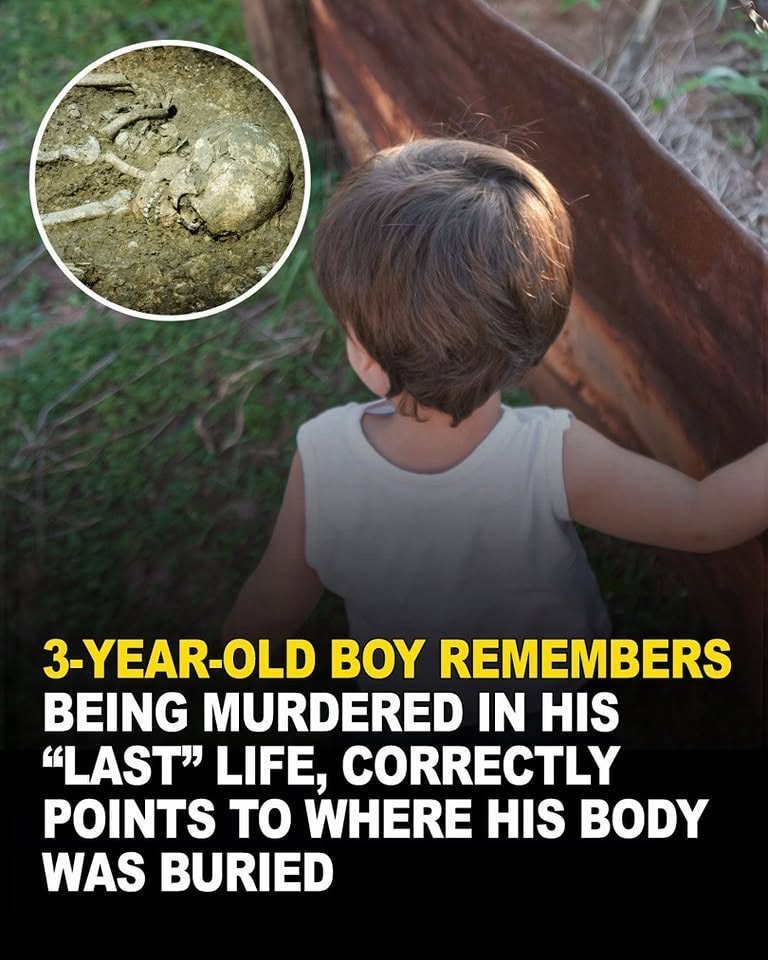
Toddler Claims to Remember Being Murdered in a Past Life — and Identifies Where He Was Buried
Stories about young children who appear to remember events from a life they never experienced have fascinated people for decades.
One particularly unusual story involves a young child who reportedly claimed that he had been murdered in a previous life and was able to provide information about where his body had been buried.
The story has attracted attention because of the details the child allegedly provided and the questions it raises about memory, childhood imagination, and the possibility of past-life memories.
However, it is important to remember that such stories are not considered scientific proof of reincarnation.
The Child’s Unusual Claims
According to the story, the child began talking about events that appeared to belong to a different life.
Rather than simply describing a dream or imaginary character, he reportedly spoke as though he remembered being another person.
One of the most disturbing parts of his account was the claim that he had been murdered.
He allegedly provided information about the circumstances surrounding his supposed death and eventually indicated a location where he believed his body had been buried.
For the people around him, these claims were difficult to explain.
Why the Story Attracted Attention
Children sometimes create elaborate stories, imaginary characters, and fictional situations.
What made this particular story unusual was the claim that the child provided details that adults believed could be connected to a real person or event.
The story therefore became interesting to people who study unusual reports of childhood memories.
Some researchers have collected cases in which young children reportedly describe names, places, people, or events that their families say the children could not have known about through ordinary experience.
These reports are sometimes described as claimed past-life memories.
The Alleged Location of the Burial
One of the most striking elements of the story is the child’s alleged ability to identify where he had been buried.
According to the account, the child pointed to or described a particular location.
People then reportedly investigated the area.
The story claims that information discovered at the location appeared to correspond with some of the child’s statements.
This is presented as one of the strongest parts of the story.
However, extraordinary claims require careful documentation.
A story published online does not necessarily provide enough independent evidence to establish that the events happened exactly as described.
Could a Child Really Remember a Previous Life?
This is one of the most difficult questions raised by stories like this.
Some researchers have investigated reports of children who claim to remember previous lives.
One explanation proposed by believers in reincarnation is that these children may retain memories from a previous existence.
However, mainstream science has not established reincarnation as a scientifically demonstrated explanation for these reports.
There are also other possible explanations.
Possible Psychological Explanations
Children have extremely active imaginations and can sometimes create stories that sound surprisingly detailed.
They may also unintentionally combine:
- Things they have heard
- Stories told by adults
- Television or internet content
- Dreams
- Conversations
- Personal experiences
- Imagination
A child may genuinely believe a story without deliberately making it up.
The Role of Suggestion
Another important factor is suggestion.
When adults repeatedly ask a child questions about an unusual story, the child may gradually add new details.
For example, questions such as:
“Where did this happen?”
“Who was there?”
“What happened next?”
can unintentionally encourage a child to construct a more detailed narrative.
This is one reason researchers studying children’s memories must be extremely careful about how questions are asked.
Childhood Memory Is Complicated
Human memory is not a perfect recording of events.
Memories can change over time.
Adults can sometimes remember events incorrectly, and children’s memories can be even more vulnerable to suggestion and reconstruction.
A child who says something unusual may be sincerely reporting what they believe they remember.
That does not necessarily mean the event actually occurred in the way the child describes it.
Could the Child Have Learned the Information Normally?
Another question researchers would need to consider is whether the child could have obtained the information through ordinary means.
For example, investigators would need to determine:
- Who the child had spoken with
- What the child had previously heard
- What books or videos were available to the child
- Whether adults had discussed the subject nearby
- Whether the information was publicly available
- Whether the child’s statements were recorded before investigators found the alleged evidence
These details are important because they can help distinguish an unexplained claim from information that may have been acquired normally.
Why Independent Verification Matters
Suppose a child gives ten pieces of information about an alleged previous life.
If investigators later find that several pieces appear to match a real person, that may seem extraordinary.
But researchers would still need to ask:
- Were the statements recorded before the investigation?
- Were the statements specific or vague?
- How many details did not match?
- Could the information have been obtained normally?
- Were investigators aware of the proposed answer beforehand?
- Were independent researchers involved?
Without this information, it is difficult to determine how strong the evidence really is.
Reincarnation and Cultural Beliefs
Belief in reincarnation exists in several religious and cultural traditions around the world.
In some cultures, stories about children remembering previous lives are taken particularly seriously.
In other cultures, such experiences may be interpreted as imagination, dreams, spiritual experiences, or psychological phenomena.
The interpretation often depends heavily on cultural and personal beliefs.
Why Children Are Often the Focus of These Stories
Interestingly, many reports of alleged past-life memories involve young children.
One possible reason is that young children are naturally more willing to describe unusual thoughts and experiences without filtering them through adult expectations.
Another possibility is that childhood memories are more easily influenced by imagination and suggestion.
Researchers therefore continue to debate how such reports should be interpreted.
A Fascinating Story, but Not Scientific Proof
The story of the toddler who allegedly remembered being murdered and identified his burial location is certainly fascinating.
If the details are accurately reported and independently verified, they would raise interesting questions about memory and human consciousness.
However, a compelling story is not the same thing as scientific evidence.
To establish an extraordinary claim scientifically, researchers would need reliable documentation, independent verification, controlled investigation, and consideration of alternative explanations.
Without that level of evidence, the story should be treated as an intriguing anecdote rather than proof that reincarnation exists.
What Can We Learn From the Story?
Regardless of whether someone believes in reincarnation, stories like this highlight how mysterious human memory can be.
They also demonstrate the importance of asking careful questions.
When someone reports an extraordinary experience, we can remain curious while also asking:
- What exactly was said?
- When was it said?
- Was it recorded?
- Who was present?
- Could the information have been learned normally?
- Was the claim independently verified?
- Are there alternative explanations?
These questions help separate an interesting story from a scientifically established fact.
Conclusion
The story of a toddler who allegedly remembered being murdered in a past life and identified where he had been buried is one of many unusual accounts involving claimed past-life memories.
The story is compelling because of the apparent specificity of the child’s statements.
Nevertheless, there are multiple possible explanations for such experiences, including imagination, suggestion, memory formation, information learned from the child’s environment, and coincidence.
Reincarnation remains a matter of religious belief and philosophical debate rather than an established scientific fact.
For that reason, the story is best viewed as an intriguing mystery rather than definitive evidence of a previous life.