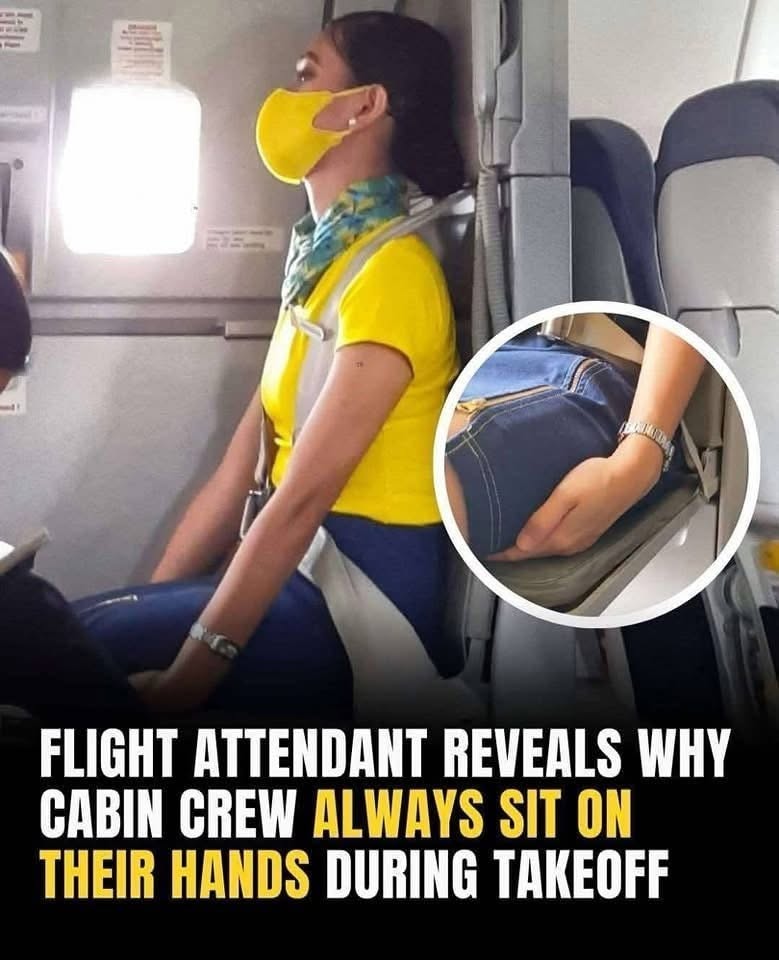
Flight Attendant Explains Why Cabin Crew Keep Their Hands Under Their Thighs During Takeoff and Landing
If you have ever paid close attention to flight attendants during takeoff and landing, you may have noticed something unusual.
Some cabin crew members sit with their hands placed underneath their thighs while the aircraft is accelerating, taking off, or preparing to land.
At first, this position may seem strange.
Why would a flight attendant deliberately place their hands under their legs during one of the most important phases of a flight?
The explanation is connected to safety, posture, and the way cabin crew are trained to prepare themselves for unexpected forces.
What Is the Position Called?
The position is commonly associated with a type of braced seating posture.
During takeoff and landing, cabin crew sit in their designated jump seats and adopt a specific body position designed to help protect them if the aircraft experiences sudden movement or an unexpected impact.
The exact posture can vary depending on the airline and aircraft.
In some situations, crew members may place their hands underneath their thighs rather than leaving their arms freely positioned.
Why Do Flight Attendants Do This?
The basic idea is to keep the body in a stable and controlled position during the most critical phases of flight.
Takeoff and landing are considered particularly important phases because the aircraft is closer to the ground and cabin crew must be prepared to respond quickly if something unexpected happens.
A stable posture can help reduce uncontrolled movement of the arms and legs.
It can also help crew members maintain a consistent position during an emergency.
Preparing for Unexpected Movement
An aircraft can sometimes experience sudden movement.
This may happen because of:
- Sudden braking
- Strong turbulence
- A hard landing
- Rapid acceleration or deceleration
- An unexpected aircraft movement
- An emergency situation
If a flight attendant is already seated and properly positioned, they are less likely to be thrown around the cabin by a sudden change in motion.
This is one reason why cabin crew are required to use their designated seats and follow specific safety procedures.
Why Keep the Hands Under the Thighs?
One explanation for this hand position is that it helps keep the arms close to the body.
During a sudden movement, freely positioned arms could potentially move unpredictably.
Keeping the hands in a controlled position reduces unnecessary movement.
The position may also help maintain a consistent bracing posture.
However, passengers should not assume that this exact hand position is mandatory for every airline or aircraft.
Cabin crew follow the procedures established by their airline and aviation authorities.
Takeoff and Landing Are Special Phases
Flight attendants do not normally remain seated throughout an entire flight.
During most of the flight, they may be:
- Serving passengers
- Checking the cabin
- Communicating with the cockpit
- Preparing food and drinks
- Assisting passengers
- Performing safety checks
During takeoff and landing, however, they must return to their assigned jump seats.
This allows them to be properly secured and ready for an emergency if necessary.
What Is a Jump Seat?
A jump seat is the specialized seat used by cabin crew.
These seats are designed differently from ordinary passenger seats.
They usually include:
- A restraint system
- A secure seating position
- A location that provides access to the cabin
- Safety equipment nearby
The position of the jump seat allows crew members to monitor the cabin and respond quickly when necessary.
The Importance of the Brace Position
Cabin crew are trained to use specific body positions during takeoff and landing.
These positions are designed to reduce the risk of injury in the event of sudden deceleration or impact.
The exact procedure may differ between airlines.
A typical braced posture may involve:
- Sitting upright
- Keeping the feet firmly positioned
- Keeping the body stable
- Following the airline’s prescribed hand and arm position
- Securing the safety harness or restraint
The goal is not to make the position look comfortable.
The goal is to create a stable and repeatable posture that can be used during an emergency.
Why Don’t Flight Attendants Simply Hold Their Hands in Their Lap?
Passengers may wonder why crew members do not simply place their hands normally on their laps.
The answer is that cabin crew safety procedures are carefully designed and practiced.
The placement of the hands is part of a larger posture.
It is not an isolated trick.
The entire seating position—including the head, back, feet, arms, and restraint—is intended to help protect the crew member.
Cabin Crew Are Trained for Emergencies
Flight attendants are not simply responsible for serving food and drinks.
They are trained safety professionals.
Their training can include:
- Emergency evacuation procedures
- Fire response
- First aid
- CPR
- Passenger management
- Emergency equipment
- Water evacuation procedures
- Aircraft-specific safety procedures
They must also practice responding to situations where they have very little time to react.
This is why their behavior during takeoff and landing may look very deliberate.
Why Is Consistency Important?
In an emergency, there may be no time to think about where to put your hands or how to position your body.
Training creates automatic responses.
By repeatedly practicing the same procedure, cabin crew can perform it quickly and consistently.
This is especially important during takeoff and landing because these phases require the cabin to be secured and the crew to be seated.
Does This Mean Something Is Wrong With the Plane?
No.
Seeing a flight attendant place their hands under their thighs does not mean that the aircraft is experiencing a problem.
It is simply part of a safety posture that may be used during takeoff and landing.
Passengers should not interpret this behavior as a warning sign.
In fact, the crew’s calm and consistent behavior is part of normal aviation safety procedures.
Should Passengers Copy the Same Position?
Passengers should always follow the safety instructions provided by their airline.
Passenger brace positions can be different from cabin crew procedures.
If an emergency occurs, passengers should listen carefully to the cabin crew and follow their instructions.
The most important things include:
- Fastening the seat belt
- Keeping the seat belt properly tightened
- Following crew instructions
- Keeping the seat in the required position
- Stowing loose objects
- Paying attention to the safety briefing
Passengers should not attempt to imitate a flight attendant’s exact posture unless instructed to do so.
Why Takeoff and Landing Receive So Much Attention
Takeoff and landing require particular attention because the aircraft is transitioning between ground and flight operations.
During these phases:
- Cabin crew must be seated
- Passengers must be properly restrained
- Carry-on items must be secured
- Tray tables and seats must be positioned correctly
- Cabin crew must be prepared for an emergency
These procedures are designed to reduce risks and ensure that everyone is ready to respond if something unexpected happens.
The Real Purpose Behind the Position
The unusual hand position is not about comfort or appearance.
It is part of a broader approach to emergency preparedness.
By keeping the body stable and the hands controlled, cabin crew can maintain a consistent posture while seated in their jump seats.
This can help reduce unnecessary movement and prepare them for sudden forces.
A Small Detail With a Bigger Safety Purpose
For passengers, the position may seem like a strange habit.
For cabin crew, however, it is simply part of professional safety training.
Flight attendants spend considerable time learning how to respond to emergencies, and even seemingly small details—such as how to sit during takeoff and landing—can be part of that training.
Conclusion
The next time you see a flight attendant sitting with their hands under their thighs during takeoff or landing, there is no need to be concerned.
The position is associated with the cabin crew’s braced seating posture and is intended to help them remain stable and prepared during critical phases of flight.
The exact procedure can vary between airlines and aircraft, so the position should not be treated as a universal rule.
Ultimately, what may look like an unusual habit is simply another example of how aviation safety relies on careful training, preparation, and consistent procedures.